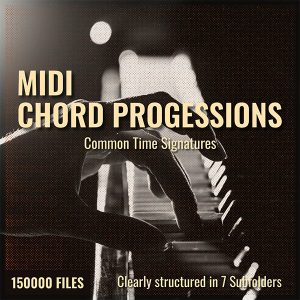
150,000 MIDI Chord Progressions for Common Time Signatures
Explore 150,000 MIDI Chord Progressions designed for songwriting, composing and music production in common time signatures.
This extensive collection gives you a large selection of editable harmonic ideas to develop songs, electronic arrangements, piano compositions and instrumental music.
🎹 What’s Included:
150,000 MIDI chord progressions
Harmonic sequences for common time signatures
Editable MIDI note information
Flexible chord material for songwriting and arrangement
Musical starting points for different production styles
🎧 From Chord Progression to Your Own Composition
Choose a MIDI progression, import it into your DAW and assign your preferred piano, synthesizer or virtual instrument.
Experiment with different keys, chord voicings, note lengths and rhythmic patterns. Build melodies, basslines and additional instrumental layers around the selected harmony.
Whether you’re producing Pop, EDM, House, Hip-Hop, Ambient or cinematic music, the MIDI format allows you to adapt the harmonic material to your own musical direction.
Format: MIDI chord progressions. A compatible DAW and suitable virtual instruments are required to hear the notes as instrument sounds.
Discover 150,000 editable harmonic starting points for your next music project.

Related Articles
Gib hier deinen Absatz ein

150,000 MIDI Chord Progressions for Music Production
Explore a large collection of 150,000 MIDI Chord Progressions for common time signatures, created for producers, songwriters and composers who want to experiment with musical harmony.
Chord progressions provide a foundation for melodies, basslines and instrumental arrangements. They help define the mood of a song and establish the relationship between different musical elements.
This MIDI chord library offers harmonic material that you can import into compatible music production software and customize using your preferred virtual instruments.
Explore Chord Progressions in Common Time Signatures
Common time signatures form the rhythmic foundation of many popular music styles.
Working with chord progressions in familiar meters makes it easier to develop arrangements around drum grooves, melodies and repeating instrumental patterns.
You can use MIDI chords to experiment with:
Piano-based songwriting
Electronic chord arrangements
Harmonic foundations for beats
Atmospheric keyboard layers
Instrumental compositions
Melodic development and arrangement variations
The collection focuses on MIDI chord progressions, giving you flexibility to adapt musical ideas instead of relying on fixed audio recordings.
Build Songs Around MIDI Chords
Start with a Harmonic Idea
Choose a chord progression and import it into your DAW.
Assign a virtual piano or keyboard instrument to hear the harmony, then experiment with different sounds and note arrangements.
You can use the progression as the harmonic foundation of a verse, chorus, breakdown or instrumental section.
Develop Melodies and Basslines
Once you’ve selected a progression, experiment with melodies that complement its harmonic movement.
You can also develop a bassline around the chord changes to create a relationship between harmony and rhythm.
The MIDI notes remain editable, allowing you to change individual chords as your arrangement develops.
Create Different Instrumental Layers
A single chord progression can be used with different instruments throughout a production.
For example, experiment with piano chords during an introduction, sustained synthesizer pads in an atmospheric section and shorter rhythmic chord stabs later in the arrangement.
Your instrument choices, effects and mixing techniques determine the final sound.
MIDI Chords for Different Music Genres
Pop and Songwriting
Explore harmonic sequences as starting points for verses, choruses and instrumental sections.
Change the key or chord voicings to complement your melody and vocal range.
EDM and House
Experiment with rhythmic chord patterns, piano arrangements and layered synthesizers.
Combine MIDI chord progressions with your preferred basslines and drum patterns to develop electronic tracks.
For additional genre-focused material, explore our House MIDI Packs.
Hip-Hop and Lo-Fi
Use chord progressions as harmonic foundations for piano-based beats, soft keyboard arrangements and atmospheric music.
Experiment with timing and note velocity to shape the rhythmic feel.
Ambient and Cinematic Music
Develop sustained harmonies and evolving instrumental layers using virtual pianos, pads or orchestral instruments.
Adjust chord durations and instrument sounds to experiment with tension, atmosphere and resolution.
Fully Editable MIDI Chord Progressions
Unlike fixed audio loops, MIDI files contain note and performance information.
This gives you control over the musical content.
You can:
Transpose progressions into different keys
Change individual notes and chords
Experiment with chord inversions
Adjust note lengths and velocity
Modify rhythmic timing
Assign different virtual instruments
Create variations for different song sections
This flexibility makes the library useful for both songwriting and music production experiments.
Learn Harmony with MIDI
MIDI chord progressions can also serve as practical material for exploring music theory.
Open a progression in your DAW’s piano roll and examine how its notes form different chords.
Experiment with chord inversions, note relationships and harmonic movement.
You can also modify individual notes to explore how a small change affects the overall character of a progression.
Compatible Music Production Software
Standard MIDI files can be imported into compatible digital audio workstations such as:
FL Studio
Ableton Live
Logic Pro
Cubase
Studio One
Reaper
Assign the imported MIDI files to suitable virtual instruments or MIDI-compatible sound generators.
MIDI files contain musical notes rather than recorded instrument sounds. A compatible instrument is required for audible playback.
How to Use the MIDI Chord Library
Choose a MIDI chord progression.
Import the file into your DAW.
Assign your preferred piano, keyboard or synthesizer.
Customize the key, notes, timing and voicings.
Build melodies, basslines and other musical elements around the progression.
Explore More Chord Progression Libraries at Sonic Dock
314,267 MIDI Chord Progressions
For an even larger common-time collection, explore our 314,267 MIDI Chord Progressions Library.
This separate collection offers a broader quantity of MIDI chord progressions for producers who want an extensive harmonic library.
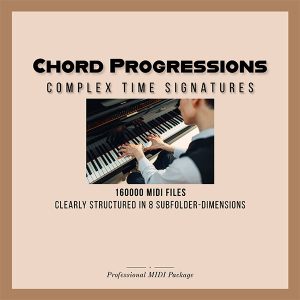
160,000 Chord Progressions for Complex Time Signatures
Interested in experimenting beyond familiar rhythmic structures?
Explore our 160,000 Chord Progressions for Complex Time Signatures.
This separate MIDI collection focuses on less conventional meters and rhythmic experimentation.
250,000+ Four-Voice MIDI Chord Progressions
For producers interested in multi-voice harmony, discover our 250,000+ Four-Voice MIDI Chord Progressions.
The collection focuses on four-voice harmonic structures.
Discover More MIDI Production Tools
Browse our MIDI Chord Progressions and Harmony Tools category for additional harmonic resources.
You can also explore the complete MIDI Packs for Music Production collection.
Digital MIDI Chord Progressions Download
This collection provides 150,000 MIDI chord progressions for common time signatures.
Use the files to explore harmonic ideas, develop melodies and create instrumental arrangements using your preferred DAW and virtual instruments.
Digital download only. No physical product will be shipped.
Explore editable harmony and develop your next composition with this extensive MIDI chord library.